1. Introduction & Motivation
The evolution from 5G to 6G necessitates a fundamental rethinking of edge computing. While the core premise—processing data closer to the source to reduce latency and bandwidth—remains compelling, its current implementation is hampered by the limited and static deployment of physical edge servers. The paper introduces Virtual Edge Computing (V-Edge) as a paradigm shift. V-Edge proposes to virtualize all available computational, storage, and networking resources across the continuum from cloud data centers to user equipment (UE), creating a seamless, scalable, and dynamic resource pool. This abstraction bridges the traditional gaps between cloud, edge, and fog computing, acting as a critical enabler for advanced microservices and cooperative computing models essential for future vertical applications and the Tactile Internet.
2. The V-Edge Architecture
The V-Edge architecture is built on a unified abstraction layer that hides the heterogeneity of underlying physical resources.
Architectural Pillars
Abstraction: Presents a uniform interface regardless of resource type (server, UE, gNB).
Virtualization: Logical pooling of distributed resources.
Orchestration: Hierarchical management for global optimization and local, real-time control.
2.1 Core Principles & Abstraction Layer
The core principle is the decoupling of service logic from physical infrastructure. An abstraction layer defines standard APIs for resource provisioning, monitoring, and lifecycle management, similar to how IaaS clouds abstract physical servers. This allows service developers to request "edge resources" without specifying exact physical locations.
2.2 Resource Virtualization & Pooling
V-Edge virtualizes resources from the cloud back-end, 5G core and RAN infrastructure, and end-user devices (smartphones, IoT sensors, vehicles). These virtualized resources are aggregated into logical pools that can be elastically allocated to services based on demand and constraints (e.g., latency, data locality).
2.3 Hierarchical Orchestration
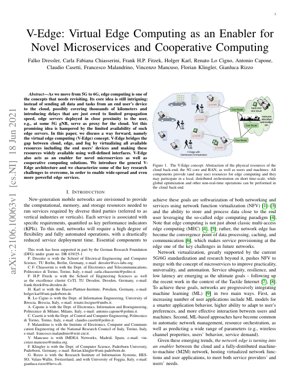
Orchestration operates on two timescales: (1) A global orchestrator in the cloud performs long-term optimization, service admission, and high-level policy enforcement. (2) Local orchestrators at the edge handle real-time, latency-critical decisions like instant service migration or cooperative task offloading among nearby devices, as illustrated in Figure 1 of the PDF.
3. Key Research Challenges
Realizing V-Edge requires overcoming significant technical hurdles.
3.1 Resource Discovery & Management
Dynamically discovering, characterizing (CPU, memory, energy, connectivity), and registering highly volatile resources, especially from mobile user equipment, is non-trivial. Efficient distributed algorithms are needed for real-time resource cataloging.
3.2 Service Placement & Migration
Deciding where to place or migrate a service component (microservice) is a complex optimization problem. It must jointly consider latency $L$, resource cost $C$, energy consumption $E$, and network conditions $B$. A simplified objective can be modeled as minimizing a weighted sum: $\min(\alpha L + \beta C + \gamma E)$ subject to constraints like $L \leq L_{max}$ and $B \geq B_{min}$.
3.3 Security & Trust
Incorporating untrusted third-party devices into the resource pool raises major security concerns. Mechanisms for secure isolation (e.g., lightweight containers/TEEs), attestation of device integrity, and trust management for resource contributors are paramount.
3.4 Standardization & Interfaces
The success of V-Edge hinges on open, standardized interfaces for abstraction and orchestration. This requires convergence and extension of standards from ETSI MEC, 3GPP, and cloud-native communities (Kubernetes).
4. Enabling Novel Microservices
V-Edge's granular resource control perfectly aligns with the microservices architecture. It enables:
- Ultra-Low Latency Microservices: Placing latency-critical microservices (e.g., object detection for AR) on the nearest virtualized resource, potentially a nearby smartphone.
- Context-Aware Services: Microservices can be instantiated and configured based on real-time context (user location, device sensors) available at the edge.
- Dynamic Composition: Services can be composed on-the-fly from microservices distributed across the V-Edge continuum.
5. Cooperative Computing Paradigm
V-Edge is a foundational enabler for cooperative computing, where multiple end-user devices collaboratively execute tasks. For example, a group of vehicles can form a temporary "edge cluster" to process collective perception data for autonomous driving, offloading only aggregated results to a central cloud. V-Edge provides the management fabric to discover nearby devices, partition tasks, and orchestrate this cooperation securely and efficiently.
6. Technical Framework & Mathematical Modeling
The service placement problem can be formalized. Let $S$ be the set of services, each composed of microservices $M_s$. Let $R$ be the set of virtualized resources (nodes). Each resource $r \in R$ has capacity $C_r^{cpu}, C_r^{mem}$. Each microservice $m$ has requirements $d_m^{cpu}, d_m^{mem}$ and generates data flow to other microservices. The placement is a binary decision variable $x_{m,r} \in \{0,1\}$. A classic objective is to minimize total network latency while respecting capacity constraints: $$\min \sum_{m, n \in M} \sum_{r, q \in R} x_{m,r} \cdot x_{n,q} \cdot lat(r,q)$$ subject to: $$\sum_{m \in M} x_{m,r} \cdot d_m^{cpu} \leq C_r^{cpu}, \quad \forall r \in R$$ This is an NP-hard problem, requiring heuristic or ML-based solvers for real-time operation.
Figure 1 Interpretation (Conceptual)
The central figure in the PDF depicts the V-Edge abstraction layer spanning cloud, 5G core/RAN, and end-user devices. Arrows indicate bidirectional resource provisioning and usage. The diagram highlights a two-tier orchestration: local, fast control loops at the edge for cooperative computing, and a global, slower optimization loop in the cloud. This visualizes the core thesis of a unified but hierarchically managed virtual resource continuum.
7. Analysis & Critical Perspective
Core Insight
V-Edge isn't just an incremental upgrade to MEC; it's a radical re-architecting of the compute continuum. The paper correctly identifies that the scarcity of physical edge servers is a fundamental bottleneck for 6G ambitions like the Tactile Internet. Their solution—treating every device as a potential resource—is bold and necessary, echoing the shift from centralized data centers to hybrid cloud. However, the vision is currently stronger on architecture than on the gritty details of implementation.
Logical Flow
The argument is logically sound: 1) Identify the limitation of current edge models. 2) Propose virtualization as the unifying abstraction. 3) Detail the architectural components (abstraction, pooling, orchestration). 4) Enumerate the hard problems that must be solved (security, placement, etc.). 5) Highlight the transformative use cases (microservices, cooperation). It follows the classic research paper structure of problem-solution-challenges-impact.
Strengths & Flaws
Strengths: The paper's major strength is its holistic, system-level view. It doesn't just focus on algorithms or protocols but presents a coherent architectural blueprint. Linking V-Edge to microservices and cooperative computing is astute, as these are dominant trends in software and networking research (e.g., seen in the evolution of Kubernetes and research on federated learning at the edge). The acknowledgment of security as a primary challenge is refreshingly honest.
Flaws & Gaps: The elephant in the room is the business and incentive model. Why would a user donate their device's battery and compute? The paper mentions it only in passing. Without a viable incentive mechanism (e.g., tokenized rewards, service credits), V-Edge risks being a resource pool filled only by network operators' infrastructure, reverting to a slightly more flexible MEC. Furthermore, while the paper mentions Machine Learning (ML), it underplays its role. ML isn't just for use cases; it's critical for managing V-Edge—predicting resource availability, optimizing placement, and detecting anomalies. The work of organizations like the LF Edge Foundation shows that industry is grappling with these exact orchestration complexities.
Actionable Insights
For researchers: Focus on the incentive-compatible resource sharing problem. Explore blockchain-based smart contracts or game-theoretic models to ensure participation. The technical challenges of service placement are well-known; the socio-technical challenge of participation is not.
For industry (Telcos, Cloud Providers): Start building the orchestration software now. The abstraction layer APIs are the moat. Invest in integrating Kubernetes with 5G/6G network exposure functions (NEF) to manage workloads across cloud and RAN—this is the pragmatic first step towards V-Edge.
For standard bodies (ETSI, 3GPP): Prioritize defining standard interfaces for resource exposure from user equipment and lightweight edge nodes. Without standardization, V-Edge becomes a collection of proprietary silos.
In summary, the V-Edge paper provides an excellent north star. But the journey there requires solving harder problems in economics and distributed systems than in pure networking.
8. Future Applications & Research Directions
- Metaverse and Extended Reality (XR): V-Edge can dynamically render complex XR scenes across a cluster of nearby devices and edge servers, enabling persistent, high-fidelity virtual worlds with minimal motion-to-photon latency.
- Swarm Robotics & Autonomous Systems: Fleets of drones or robots can use the V-Edge fabric for real-time, distributed consensus and collaborative mapping without relying on a central controller.
- Personalized AI Assistants: AI models can be partitioned, with private data processed on the user's device (a V-Edge resource), while larger model inference runs on neighboring resources, balancing privacy, latency, and accuracy.
- Research Directions:
- AI-Native Orchestration: Developing ML models that can predict traffic, mobility, and resource patterns to proactively orchestrate the V-Edge.
- Quantum-Safe Security for Edge: Integrating post-quantum cryptography into the lightweight trust frameworks of V-Edge.
- Energy-Aware Orchestration: Algorithms that optimize not just for performance but for total system energy consumption, including end-user device battery life.
9. References
- ETSI, "Multi-access Edge Computing (MEC); Framework and Reference Architecture," ETSI GS MEC 003, 2019.
- M. Satyanarayanan, "The Emergence of Edge Computing," Computer, vol. 50, no. 1, pp. 30-39, Jan. 2017.
- W. Shi et al., "Edge Computing: Vision and Challenges," IEEE Internet of Things Journal, vol. 3, no. 5, pp. 637-646, Oct. 2016.
- P. Mach and Z. Becvar, "Mobile Edge Computing: A Survey on Architecture and Computation Offloading," IEEE Communications Surveys & Tutorials, vol. 19, no. 3, pp. 1628-1656, 2017.
- LF Edge Foundation, "State of the Edge Report," 2023. [Online]. Available: https://www.lfedge.org/
- I. F. Akyildiz, A. Kak, and S. Nie, "6G and Beyond: The Future of Wireless Communications Systems," IEEE Access, vol. 8, pp. 133995-134030, 2020.
- G. H. Sim et al., "Toward Low-Latency and Ultra-Reliable Virtual Reality," IEEE Network, vol. 32, no. 2, pp. 78-84, Mar./Apr. 2018.
- M. Chen et al., "Cooperative Task Offloading in 5G and Beyond Networks: A Survey," IEEE Internet of Things Journal, 2023.